
NASA installs seven-camera DragonCam imaging system on Titan-bound Dragonfly rotorcraft
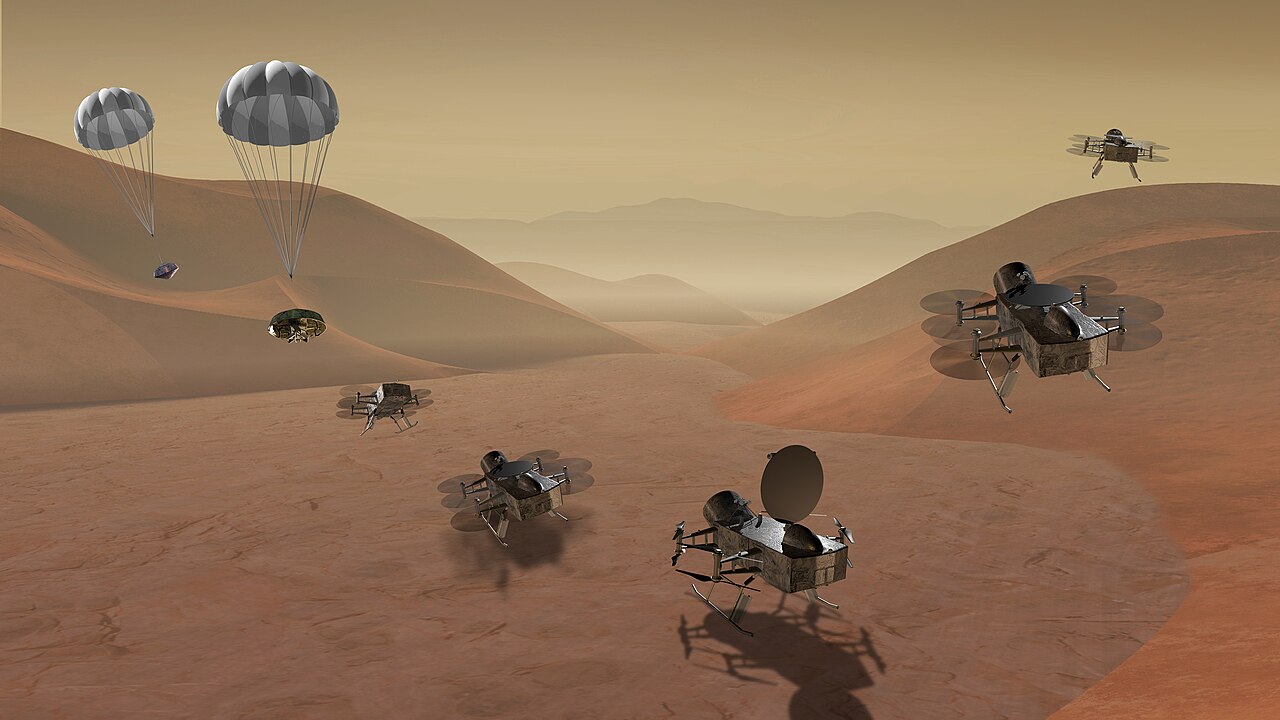
Engineers at the Johns Hopkins Applied Physics Laboratory have integrated and tested all seven science cameras on NASA's car-sized Dragonfly octocopter, marking a major assembly milestone ahead of its planned July 2028 launch to Saturn's largest moon.

On November 24, 2026, NASA and the Johns Hopkins Applied Physics Laboratory (APL) announced that the seven-camera DragonCam science imaging suite has been fully installed, insulated, and tested aboard the Dragonfly rotorcraft in Laurel, Maryland. Built by Malin Space Science Systems in San Diego, DragonCam is the first of five major scientific instrument packages to be integrated into the spacecraft, which is scheduled to launch no earlier than July 2028 and arrive at Titan in late 2034.
The milestone follows the summer 2026 installation of two separate navigation cameras, also built by Malin Space Science Systems, and moves the New Frontiers mission from structural assembly into full science payload integration.
How DragonCam will capture Titan from air and ground
Unlike stationary landers or wheeled rovers, Dragonfly is designed to fly across Titan's dense, nitrogen-rich atmosphere and examine multiple geological regions. According to NASA's announcement, technicians Chad Cook and Seth Harvey installed DragonCam's high-resolution microscopic imager on November 6, 2026, and all seven cameras were integrated into their flight housings by mid-November.
Each camera is mounted inside a protective foam enclosure and looks outward through a window designed to shield the optics and internal electronics from Titan's extreme cold, where surface temperatures drop to minus 290 degrees Fahrenheit (around minus 143 degrees Celsius), as detailed by Johns Hopkins APL.
The seven-camera suite divides imaging duties across four distinct viewing angles:
- Forward stereoscopic pair: One wide-angle camera (WAC) with a 90-degree field of view works alongside an overlapping, higher-resolution medium-angle camera (MAC) to generate 3D-like depth perspective ahead of the lander.
- Side-mounted panoramas: Two side-facing WACs combine with the forward WAC to stitch together sweeping panoramic views of Titan's dunes and craters.
- Downward hazard checks: Two downward-facing WACs inspect the ground directly beneath the rotorcraft so mission operators can verify safe placement for Dragonfly's seismometer and sampling drill.
- Microscopic grain imaging: A high-resolution microscopic imager targets the drill site to resolve millimeter-sized sand grains around each sampling location.
On November 9, 2026, shortly after installation, DragonCam's forward and side wide-angle cameras captured their first three-image panoramic test shot inside the APL cleanroom, showing the rotorcraft's top deck, circular high-gain antenna, and engineers in the control room windows. The test image carried a yellow tint because the cameras register light wavelengths differently than the human eye, according to NASA.
Seeing through Titan's eight-day night
To overcome Titan's dim, hazy daylight and long nights—a single Titan day, or Tsol, lasts roughly 16 Earth days, meaning night stretches for nearly eight Earth days—APL engineers built a configurable LED array that spans wavelengths from infrared to ultraviolet.
This lighting system serves two practical purposes. First, it allows scientists to reconstruct true-color views of surface materials as human eyes would see them. Second, ultraviolet illumination can trigger fluorescence in certain organic molecules during the lunar night, helping researchers infer the chemical composition of surface deposits before drilling.
"With the capability to take images when Dragonfly is on the surface as well as while flying, DragonCam will give us both detailed views and sweeping panoramas of Titan's landscape, as well as insight into the processes that shaped this extraordinary world."
— Elizabeth "Zibi" Turtle, Dragonfly principal investigator at APL
Michael Ravine, DragonCam development manager at Malin Space Science Systems, noted that having the cameras mounted and taking test images brings the operational phase into clearer focus, while DragonCam instrument scientist Carolyn Ernst emphasized that the imagery will tie drilled samples to Titan's broader geology.
Mission background: a flying laboratory powered by nuclear heat
Selected in 2019 as the fourth mission in NASA's New Frontiers program, Dragonfly is roughly the size of a car, weighing 1,900 pounds (875 kg) and measuring 12.5 feet (3.85 m) long and wide by 5.5 feet (1.75 m) tall, with eight sets of 53-inch (1.35 m) coaxial rotor blades.
Because Saturn orbits far from the Sun and Titan's thick atmospheric haze blocks most sunlight, solar panels cannot power the vehicle. Instead, Dragonfly pairs a 134-ampere-hour battery with a Multi-Mission Radioisotope Thermoelectric Generator (MMRTG) supplied by the U.S. Department of Energy—the same class of nuclear power source used on NASA's Curiosity and Perseverance Mars rovers.
Over its planned 3.3-year primary mission, Dragonfly is expected to fly once every one to two Tsols, covering roughly 70 miles (115 km) from its initial landing site and visiting 20 to 30 distinct locations, including organic sand dunes and Selk Crater.
Over the coming months, APL will integrate Dragonfly's remaining four instrument suites:
- DrACO (Drill for Acquisition of Complex Organics), built by Honeybee Robotics, to drill and pneumatically transfer surface samples inside the lander.
- DraMS (Dragonfly Mass Spectrometer), developed by NASA's Goddard Space Flight Center and France's CNES, to analyze prebiotic organic chemistry.
- DraGNS (Gamma-ray and Neutron Spectrometer), led by APL and Lawrence Livermore National Laboratory, to measure elemental surface composition.
- DraGMet (Geophysics and Meteorology package), developed by APL and Japan's JAXA, to track Titan's weather, regolith properties, and seismic activity.
Why it matters
For planetary scientists and the broader public, DragonCam's installation marks a decisive shift from spacecraft design to functional science hardware on one of the most ambitious robotic explorers ever built. Titan is the only moon in the solar system with a thick atmosphere and liquid hydrocarbon rivers, lakes, and seas on its surface, making it a natural laboratory for studying prebiotic chemistry—the chemical building blocks that preceded life on Earth.
By combining aerial mobility with microscopic and spectral imaging, Dragonfly will do what no single rover or stationary probe could accomplish: scout safe landing zones from above, inspect sand grains down to the millimeter scale, and map how organic compounds vary across dozens of miles of alien terrain.
Verified Sources & References
Think Today News verifies reporting against primary records, accredited institutions, and official data.
Spotted an error? Write to dileep@zentixservices.com. Read our corrections policy.