

Sonam Wangchuk and the Ice Stupas: how Ladakh's engineer-innovator blends indigenous wisdom with solar architecture
From founding SECMOL and pioneering passive solar mud buildings to inventing artificial glaciers called Ice Stupas, Sonam Wangchuk's indigenous innovations offer practical climate adaptation blueprints for mountain communities.

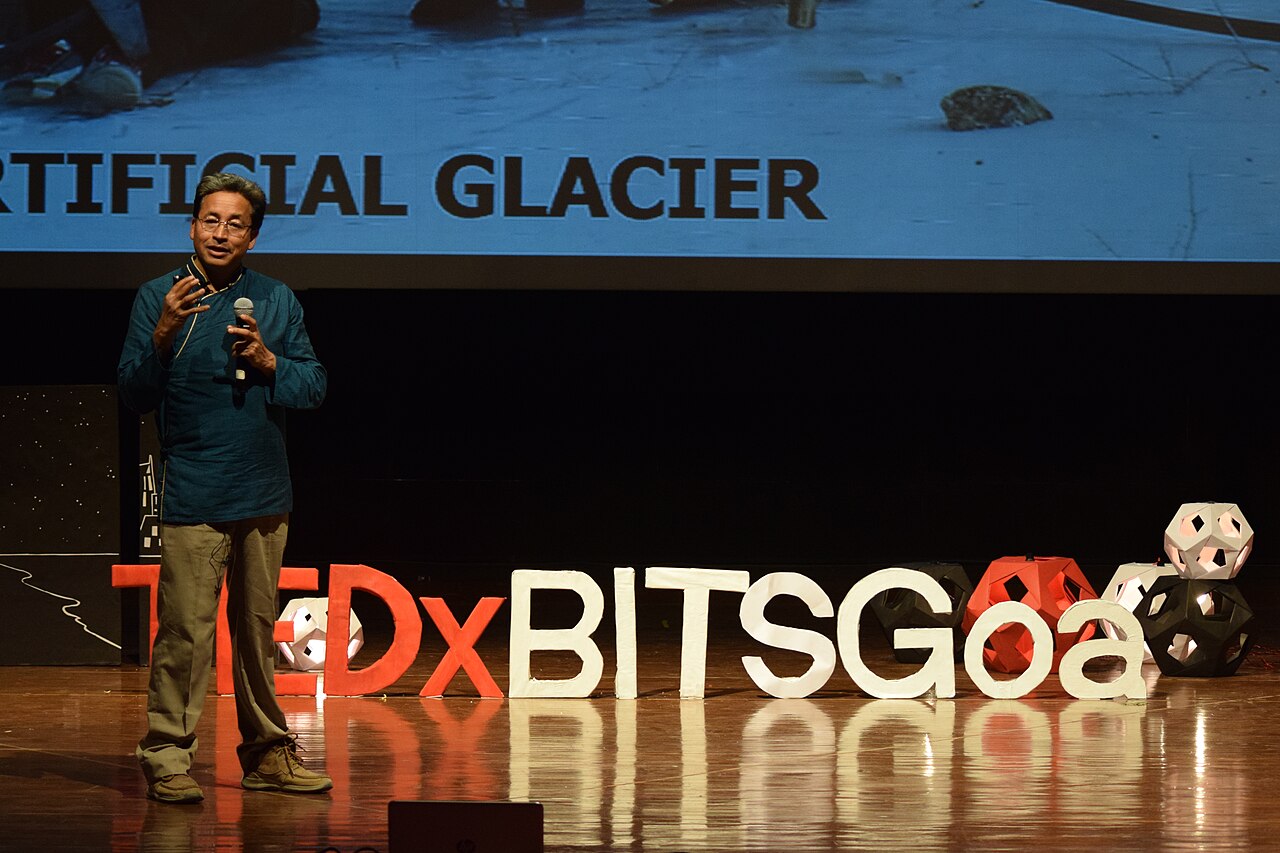
In the cold, high-altitude desert of Ladakh, where winter temperatures plunge to minus thirty degrees Celsius and annual precipitation rarely exceeds one hundred millimetres, water scarcity during the critical spring planting season has long threatened traditional Himalayan agrarian communities.
To solve this ecological challenge, mechanical engineer and educational reformer Sonam Wangchuk developed the "Ice Stupa": an artificial conical glacier that stores winter meltwater as towering ice towers, slowly releasing life-giving moisture during the arid months of April and May when farmers sow barley and peas.
Wangchuk's work, which earned him the prestigious Ramon Magsaysay Award and the Rolex Award for Enterprise, extends far beyond artificial glaciers. For over three decades, his initiatives have demonstrated that sustainable engineering must be rooted in indigenous context, experiential pedagogy, and ecological self-reliance.
SECMOL: transforming mountain education
Wangchuk's public journey began in 1988 with the establishment of the Students' Educational and Cultural Movement of Ladakh (SECMOL). At the time, the formal state education system in Ladakh suffered a catastrophic failure rate: over 95 per cent of Ladakhi students routinely failed their Class 10 matriculation examinations, largely because curricula and textbooks were designed in unfamiliar languages (Urdu and English) alienated from mountain geography.
SECMOL restructured mountain learning from the ground up:
- The Phey Campus: Built entirely of rammed earth and passive solar architecture, the SECMOL campus near Leh operates completely off-grid without burning fossil fuels or wood for heating, maintaining an internal temperature of +15°C even when outside temperatures drop below -20°C.
- Experiential learning for school dropouts: SECMOL welcomed students who had failed standard examinations, teaching practical sciences through organic agriculture, solar energy engineering, campus governance, and youth journalism.
- Operation New Hope: Partnering with the state government, SECMOL trained village teachers, introduced localised textbooks in Ladakhi, and helped increase the regional matriculation pass rate from under 5 per cent to over 75 per cent within a decade.
The engineering behind the Ice Stupa
Traditional horizontal artificial glaciers, pioneered by Ladakhi elder Chewang Norphel, worked effectively at high elevations above 4,000 metres but suffered rapid evaporation and surface melting when built closer to low-lying village fields due to direct solar exposure.
Wangchuk reimagined the geometry of ice preservation:
- Minimising surface area to volume ratio: By spraying water vertically into sub-zero winter night air through simple gravity-fed underground pipelines (requiring no electricity or pumps), water droplets freeze into a steep conical pyramid resembling a traditional Buddhist stupa.
- Delayed melting: A cone presents minimal surface area to the overhead spring sun compared to a flat sheet of ice. As a result, Ice Stupas melt three to five times slower than natural ice, continuing to supply water well into the early summer.
- Global adaptation: The Ice Stupa design has been successfully replicated across mountain ranges in Switzerland, Pakistan, and Peru, proving that frugal, zero-carbon engineering can address global glacial retreat.
Passive solar mud architecture
Beyond glaciers, Wangchuk has pioneered low-cost passive solar housing designed for extreme Himalayan winters. Standard concrete construction in Leh requires massive diesel and kerosene burning for heating, creating indoor air pollution and heavy carbon emissions.
Wangchuk's passive solar buildings combine thick rammed-earth trombe walls, double-glazed southern windows, and high-density straw-clay thermal insulation, creating zero-carbon heated homes that remain warm purely using daytime solar radiation.
His military shelter design, the "Solar-Heated Tent" developed for Indian Army soldiers deployed at high-altitude forward posts such as the Galwan Valley, replaces smoke-emitting kerosene stoves with portable solar-insulated modules, saving millions of litres of fuel and enhancing operational soldier health.
The Himalayan Institute of Alternatives (HIAL)
To institutionalise indigenous mountain problem-solving, Wangchuk founded the Himalayan Institute of Alternatives, Ladakh (HIAL). Structured as an alternative university, HIAL combines higher education with an enterprise model where students "earn while they learn" through real-world innovation in mountain tourism, climate resilience, and eco-architecture.
Wangchuk's enduring message remains simple: in an era of accelerating climate change, solutions to global ecological vulnerability will not come from blind imitation of Western industrial models, but from respectful, scientifically rigorous adaptation to local ecosystems.
Verified Sources & References
Think Today News verifies reporting against primary records, accredited institutions, and official data.
Spotted an error? Write to dileep@zentixservices.com. Read our corrections policy.